Instant Pot vs. Rice Cooker: Why I Keep a Dedicated Rice Cooker
In the Instant Pot vs. rice cooker decision, an Instant Pot is great for pressure-cooking beans, stock, and stews, and it makes decent occasional rice with a 1:1 water ratio. For families who eat rice several nights a week, though, a dedicated rice cooker like my Zojirushi NL-EAC18BA makes a huge difference: it leaves your Instant Pot free to cook the main dish, stops lid water from dripping onto the rice (bechabecha), keeps leftover rice soft without turning rock-hard (kachikochi), and never transfers garlic or curry smells from a silicone pressure ring into plain white rice.
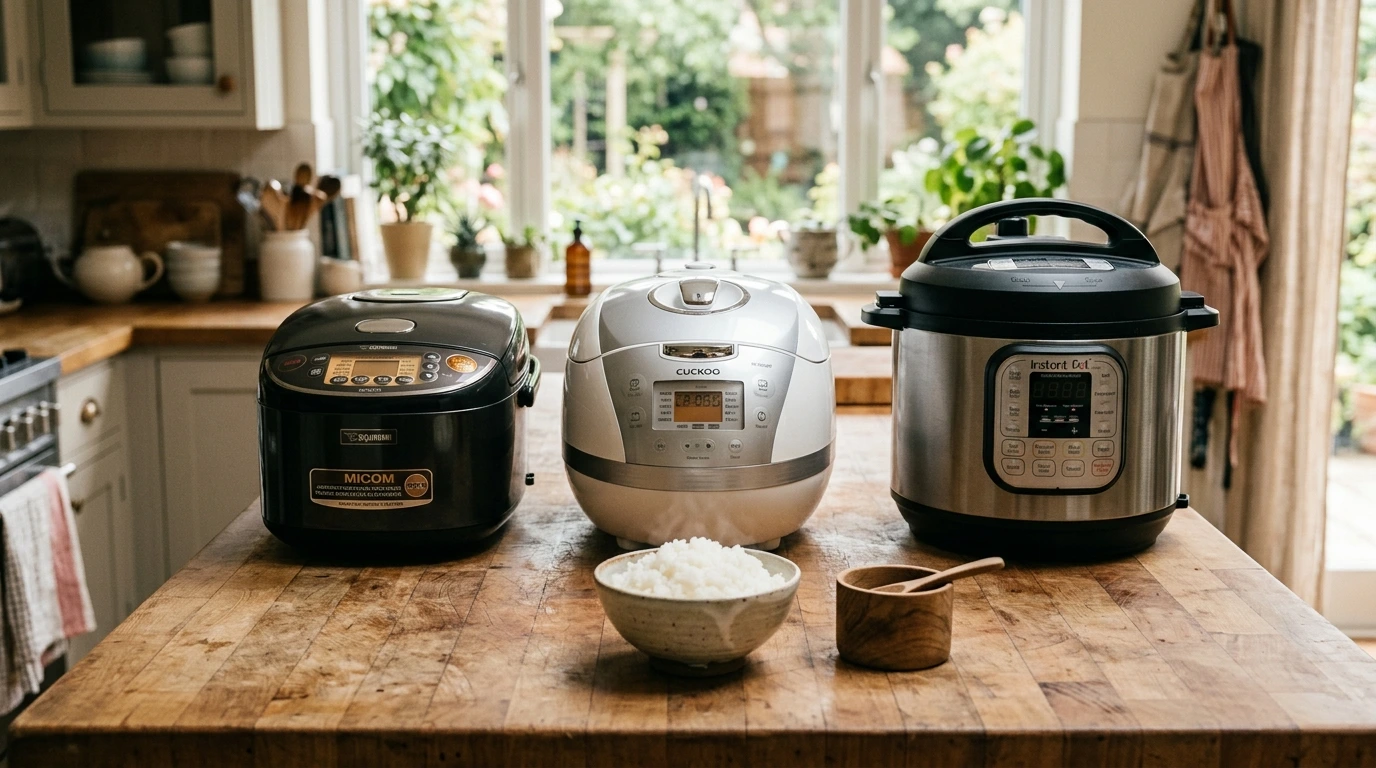
5 Daily Frustrations of Cooking Rice in an Instant Pot
- You cannot cook curry or stew and rice at the same time: If your Instant Pot is tied up for 35 minutes (10 minutes coming to pressure + 4 minutes cook + 10 minutes natural release) making rice, you cannot use it for the main dish.
- Keep-Warm turns rice hard (kachikochi /
カチコチ): In an Instant Pot, the bare stainless steel liner holds intense bottom heat. If someone comes home two hours late for dinner, the bottom layer of rice sticks to the steel and dries out. - Silicone gasket smells: The thick silicone sealing ring inside an Instant Pot lid holds onto cumin, garlic, onion, and beef broth smells. Unless you swap in a second silicone ring every time you make jasmine or sushi rice, the steam carries that smell into your plain rice.
- Lid condensation spill: When you twist and lift an Instant Pot lid off, water pooled on the steel rim rolls right onto the rice or counter.
- Faint water markings: Stamped lines on shiny stainless steel are much harder to read than bright white markings on a black Zojirushi pot.
Reviewer's note: 12-hour keep-warm with zero lid drip:With my Zojirushi NL-EAC18BA, I have left rice on keep-warm for 12 hours: no water from the steam ever drips onto the rice, the edges never turn soggy (bechabecha /
ベチャベチャ), there is zero odor on keep-warm, and the rice never turns rock-hard (kachikochi /カチコチ), though I do notice the rice has a slight yellowish tint even right when it finishes cooking. The included rice paddle (shamoji /しゃもじ) also stands up on its own next to the cooker, though rice still sticks to it a bit unless you wet it first.
Side-by-Side: Dedicated Rice Cooker vs. Instant Pot
| Feature | Dedicated Micom Rice Cooker (Zojirushi NL-EAC18BA) | Instant Pot (6-Qt / 8-Qt Pressure Multicooker) |
|---|---|---|
| White Rice Texture | Fluffy, glossy, even top-to-bottom | Acceptable, but easily overcooked or clumped at bottom |
| Keep-Warm Window | 12–24 hours soft | 1–2 hours before sticking and drying |
| Inner Pot Water Lines | High-contrast white on black pot (per grain) | Generic 1/2 and 2/3 pressure lines on shiny steel |
| Odor Transfer Risk | Zero (No savory rubber pressure ring) | High (Silicone gasket retains stew and curry smells) |
| Inner Pot Material | BPA-free double nonstick aluminum | Uncoated 304 stainless steel |
Want bare stainless steel like an Instant Pot, but in a dedicated rice cooker? See my Best Stainless Steel Rice Cookers (Tatung & Buffalo) guide.
Common Questions
Do I need a dedicated rice cooker if I already own an Instant Pot?
If you cook rice once a month, your Instant Pot is fine. If you eat rice two or more times a week, a dedicated rice cooker is much better for four reasons: it frees up your Instant Pot to cook curry or stew at the same time, its black nonstick pot has readable water marks, it never drips ring condensation onto the rice, and its Keep-Warm sensor holds rice soft for 12 to 24 hours without drying it into a crust (kachikochi).
Why does rice stick or dry out on Keep-Warm in an Instant Pot?
An Instant Pot uses a bare stainless steel pot and a single bottom heating element built for boiling broth under pressure. On Keep-Warm, the uninsulated lid and hot steel bottom dry out the bottom layer of rice within 1 to 2 hours.
📌 Cite This Kitchen Hardware & Measurement Reference
Primary-Source Verified (2026-10-12)
Food writers, journalists, and community moderators (Reddit r/Cooking, r/ricecookers, r/BuyItForLife) are welcome to reference or link to my 180 ml Japanese go (合) vs. 240 ml US cup conversions, detachable inner-lid audit, and manufacturer wattage tables with attribution to RiceHearth.